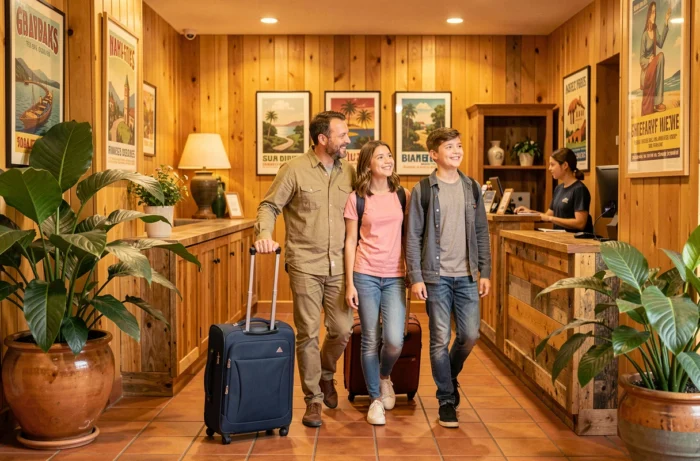
Traveling around the world with children radically changes the way you choose accommodation. The comfort of a childless couple is a hotel room with a view. The comfort of a family is a space where everyone sleeps, eats, and plays without nerves fraying by the third day.
Finding the best accommodations for a family trip requires thinking differently: in terms of available space, meal flexibility, and the ability to absorb the unpredictable rhythm of children.
Short-term rental regulations: a trap for traveling families
Have you ever booked a family apartment on a platform, only to receive a cancellation message a few weeks before departure? This scenario is becoming more common. In several very touristy destinations, the rules governing short-term rentals are tightening, sometimes at the city or regional level.
In Europe, some municipalities now require an official registration number for each property offered for rent. A property without an official number can be removed from the platform at any time. For a family organizing a world tour, this means that a property booked several months in advance can disappear from the listings without notice.
Before confirming a reservation, check that the listing displays a registration ID. Prioritize registered accommodations rather than just comparing price and amenities. This precaution avoids unpleasant surprises, especially when traveling with young children, where improvisation has its limits.
To compare different family-friendly options, the accommodations on babarautourdumonde.fr gather options tested by traveling families, making it easier to sort between reliable offers and fragile listings.
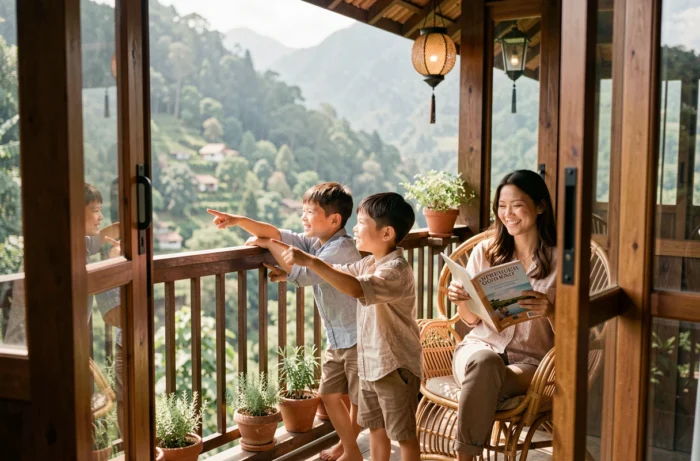
Multigenerational family accommodation: the selection criteria that change everything
Multigenerational travel (parents, children, grandparents) completely alters the criteria for choosing accommodation. A standard hotel room is no longer sufficient. One must think in terms of a shared living unit.
Separate rooms, spacious common areas, and multiple bathrooms form the basic trio. A grandparent who goes to bed early needs a secluded room. A toddler who naps requires silence in part of the accommodation. Without physical separation, tensions rise quickly.
Real accessibility or just marketing mention
Accessibility is a criterion often overlooked in searches for family accommodation. A mention of “accessible” on a booking site guarantees nothing concrete. For a family with a grandparent with reduced mobility, several specific points need to be checked:
- No steps between the entrance and the room, including in common areas
- Door widths (sufficient for a wheelchair or walker)
- The actual accessibility of the bathroom: walk-in shower, grab bars, maneuvering space
- The possibility of obtaining a room adapted to the ground floor, and not just “upon request”
Relying solely on the mention “accessible” exposes you to unpleasant surprises upon arrival. Contact the accommodation directly to ask these questions before booking.
Premium camping and family hotels: a rarely made comparison
Families often compare hotels, vacation rentals, and holiday clubs. Premium camping remains outside this framework, which is a mistake. Outdoor accommodations have transformed in recent years into credible alternatives for families traveling for extended periods.
A recent mobile home in a four-star campsite generally offers two to three bedrooms, a fully equipped kitchen, a private outdoor space, and access to a pool. For a family of four or five, the available space exceeds that of most family hotel rooms.
What premium camping adds
The main argument is not about price, but about autonomy. In hotels, meals are constrained by restaurant hours or the cost of half-board. In camping, the integrated kitchen allows for meal management at the children’s pace, significantly reducing daily stress.
The activities offered on-site (children’s clubs, playgrounds, entertainment) cater to various age groups. For a stay of more than a week in the same destination, this option provides a balance between comfort, freedom, and social life for children.
Family world tour: choosing the right format according to duration
A family world tour rarely lasts less than three months. Over this duration, alternating types of accommodation prevents fatigue and allows for budget adaptation.
- The first weeks in furnished rentals help establish a rhythm: remote schooling, shopping, anchors for the children
- Short stops (a few nights) are better suited to family hotels or hostels with private rooms
- Extended stays in a region benefit from premium camping or guesthouses with kitchens
Alternating accommodation formats on a long family trip protects both the budget and everyone’s energy. An entire month in a hotel drains the wallet. An entire month in camping can bore children who need variety.
Before each leg, ask yourself: how many nights, how many people, and what degree of autonomy for meals? These three criteria are enough to eliminate the majority of unsuitable offers and directly target the right format.
The choice of family accommodation for a long journey does not rely on standing or stars. It depends on the accommodation’s ability to absorb the daily life of a family, with its irregular schedules, space needs, and unforeseen events. Checking regulatory compliance, testing actual accessibility, and comparing formats that are rarely opposed are three reflexes that significantly change the quality of a stay.