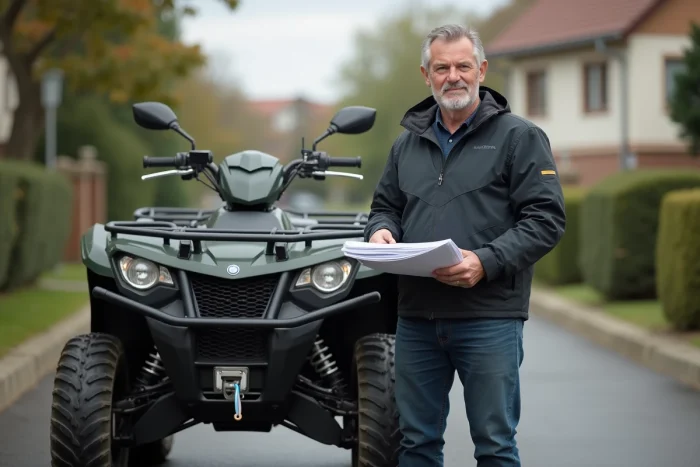
A quad with an engine capacity of over 50 cm³ that is not homologated has no place on public roads. European regulations are strict: without a certificate of conformity, it is impossible to register, even to cross a country road.
There are local exceptions, yes, but no one escapes the technical requirements set by the homologation category (L7e, T3B). A simple modification to the vehicle can jeopardize the homologation already obtained. As for the administrative procedures, they vary depending on the type of quad and the intended use.
Understanding the homologation of quads and SSVs: stakes, categories, and legal framework
Homologation defines the boundary: either your quad or SSV remains on private land, or it gains the right to use the road. A vehicle designed for agriculture or forestry does not cross this limit without meeting specific rules.
Power, usage, technical constraints, everything contributes to meticulous regulation. Depending on the weight, power, and mission of the vehicle, whether transporting loads or moving people, each quad or SSV finds its place in an official category (L7e, T3B, etc.). This classification determines the steps to follow and the equipment to add: lights, mirrors, turn signals, plates. Models homologated for road use comply with all these standards and can then leave private paths.
The law clearly differentiates between leisure quads and utility versions. Maximum speed, number of seats, safety: each aspect has its regulations. European regulations unify part of these criteria, but France adds its own rules for certain well-defined uses.
To delve deeper into the subject, everything about the homologation of maga quads can be found in this resource: What is a maga quad? – AXX Auto. This step limits the risks of infringement and protects the user during checks. Be cautious with modifications: a new accessory or a technical change may require a new administrative reception. A vigilance that weighs on the user, but which remains the condition for driving legally.
What steps to homologate a quad? Key steps and documents to prepare
Homologating a quad: the procedure
The homologation of a quad or SSV follows a strict path. Before the first registration, the vehicle undergoes reception: this technical verification guarantees compliance with regulations. Everything is checked: weight, power, lighting, safety… Nothing is left to chance for road-homologated quads.
Documents to gather to compile the file
To prepare your administrative file, here are the documents to provide:
- The certificate of conformity issued by the manufacturer, certifying that the quad meets the expected criteria for quad homologation.
- A proof of ownership, such as the invoice or sales contract.
- The civil liability insurance certificate, mandatory for any quad intended for road use.
- The application form for a registration certificate (formerly grey card), along with an identity document and proof of residence.
The administrative services verify the compliance of the file. If everything is in order and the quad complies with the highway code, a registration number is assigned: the vehicle can then circulate. This procedure applies to both new models and used quads, provided they meet current standards.
One point of attention: the isolated reception is required for models not originally intended for road use. This procedure requires technical expertise, often from the DREAL, to validate the modification and ensure compliance.

Technical standards, obligations, and checks: what regulations impose on owners
Owners of road-homologated quads face a set of requirements that are best well understood. Every step counts, from registration to daily use. Safety equipment is mandatory: compliant helmet, homologated gloves, functioning lights, regulatory mirrors, nothing should be missing to remain compliant on every trip.
Insurance leaves no margin: civil liability is imperative from the first use on the road. This coverage protects the driver, but also third parties, in case of an accident or incident. At every roadside check, one must be able to present a valid certificate.
The technical inspection is evolving. For now, most quads escape periodic checks in France, but caution is advised. Compliance with technical standards, power, type of engine, weight when loaded, lighting, remains mandatory, especially if the vehicle undergoes modifications, such as adding a tow hitch to transport goods.
This table summarizes the main obligations:
| Mandatory equipment | Objective |
|---|---|
| Helmet, gloves, lights, mirrors | Safety of the rider and compliance with the highway code |
| Insurance certificate | Cover civil liability in case of an accident |
For transporting goods, additional rules apply: weight limit, certified towing, compliance with the speed imposed by the quad category. In case of non-compliance, sanctions can occur: suspension of circulation, or even seizure of the vehicle. It is therefore better to monitor every detail to preserve the right to ride wherever legislation allows.
Homologating your quad means accepting the rigor of checks, but it also offers the freedom to access the road. It is up to each person to choose a side: improvisation or the open road under the sign of compliance.