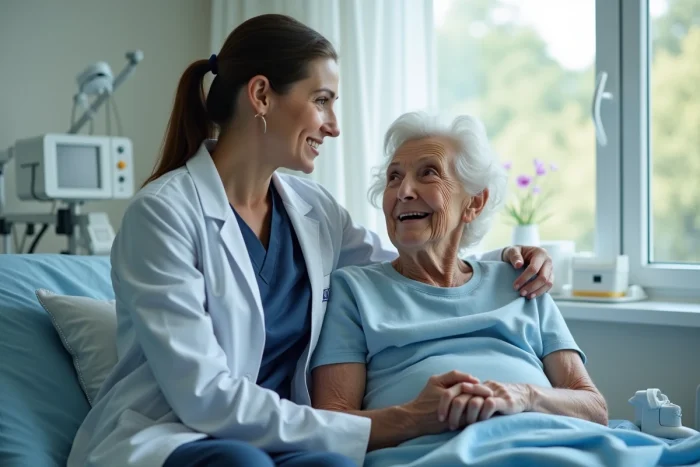
The relationship between nurse and patient has not always been established as a central element of care. The early theoretical approaches to nursing focused primarily on technical tasks and strict protocols, often neglecting the importance of human interaction. However, certain movements have disrupted these habits by giving a decisive place to interpersonal dynamics.
The theory developed by Hildegard Peplau marked a turning point in the profession. Her conceptual framework reshaped practice by emphasizing mutual understanding and the evolution of roles throughout the care process.
Hildegard Peplau: who was she and why did her theory impact nursing care?
1909, Pennsylvania. Hildegard Peplau was born into a changing America. Nothing destined her to revolutionize nursing care, yet that is precisely what she would do. A nurse, teacher, and theorist, Peplau published a work in 1952 that shattered the traditional view of care. Gone is the docile execution of prescriptions: she places the human relationship at the center and asserts that true support arises from the bond formed between caregiver and patient.
Hildegard Peplau’s theory then became an essential reference. It proposes a framework where the nurse is no longer just an executor but a partner engaged in the patient’s maturation. This model, nourished by existentialism and psychoanalysis, encourages viewing the nurse-patient relationship as an evolving process, where each learns and transforms. The nurse’s relational commitment fosters autonomy and encourages the personal development of the patient.
What does Peplau bring that is new? She structures the care relationship into several distinct stages: orientation, identification, exploitation, resolution. At each phase, different skills are mobilized, from the first meeting to the preparation for the end of support. The nurse’s posture, her ability to create connections, becomes a powerful lever for the patient’s learning and evolution.
In universities and training institutes, Peplau’s mark is profound. Her approach shapes the way nursing care is taught and practiced: better understanding relational issues, enhancing patient autonomy, and building a solid partnership between caregiver and patient remain strong focuses of training and clinical daily life.
Key concepts of interpersonal relationship theory explained simply
What makes Peplau’s strength is her dissection of the nurse-patient relationship to make it a true engine of care, both dynamic and shared. Two major inspirations run through her approach:
- the existential trend, which highlights the lived experience of the person,
- and the psychoanalytic trend, which invites exploration of the deep needs expressed behind symptoms.
At the center of this approach, the interpersonal relationship follows a marked path, with each step playing a specific role in support:
- Orientation: the first meeting. Here, the nurse and patient learn to position themselves, identify needs, and lay the foundations of an alliance.
- Identification: this is the time for exploration and engagement. The patient begins to get involved, expresses expectations, while the nurse adopts a supportive and active listening posture.
- Exploitation: the patient benefits from the help received, develops skills, gains confidence, and becomes more autonomous.
- Resolution: the relationship matures. The patient integrates what has been learned, and the caregiver prepares for separation and the handover.
Throughout these stages, the nurse’s personality and attitude play a decisive role. It is no longer just an exchange of information: practice becomes a partnership, an enriching experience for both parties. Peplau’s theory thus places nursing care on an educational ground and develops the person in all dimensions. The stated ambition: to help everyone lead a creative, constructive, productive life while respecting their uniqueness.

Concrete applications in nursing practice: how Peplau’s theory influences caregivers’ daily lives
Close to patients, Peplau’s theory manifests in the multitude of nursing roles. The nurse becomes both a resource person, guide, educator, substitute, or advisor, but above all a partner attentive to the evolution of needs and the unique history of each patient.
In the reality of the service, the interpersonal relationship shapes each support. For example, during the orientation phase, the nurse sets the framework, listens, and explains. Then, at the identification stage, the patient finally feels listened to, understood, and ready to share their expectations. Exploitation allows the patient to exercise their autonomy, while resolution prepares for a smooth exit, without rupture, with a clear transmission of what has been learned.
This model stimulates the emergence of psychosocial skills: reflective posture, self-knowledge, ability to guide without imposing. The patient, placed at the center of the process, learns to mobilize their resources and rely on their strengths. Adopting Peplau’s perspective means accepting to constantly adjust: each clinical situation calls for a nuanced reading, an adaptation, sometimes even the invention of new support tools.
Over time, caregiver and patient move forward together. The exchange goes far beyond the technical gesture: it becomes a shared adventure, transformative for both the patient and the professional. Peplau’s theory continues to nourish training, inspire research, and shape clinical practice, while reminding us of a certainty: at the heart of the profession, there is the relationship, and it is this that changes everything.