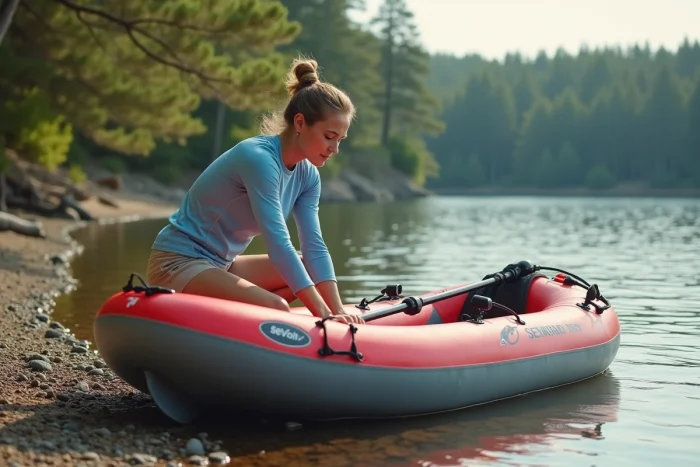
How does the Sevylor Tahiti Plus compare to other entry-level inflatable kayaks when looking at the available data, and not just the product sheet? Marketed as a family model for three people, this kayak raises several questions about its rigidity, paddling efficiency, and actual use. Here’s what tests and user feedback allow us to measure.
Bottom Rigidity and Tracking: The Tahiti Plus Against the Competition Itiwit and Aqua Marina
Comparisons published at the end of 2023 by specialized channels like Kayak Inflatable World place the Sevylor Tahiti Plus at a disadvantage on two measurable criteria: floor rigidity and tracking ability. At a comparable price level, recent Itiwit (Decathlon) and Aqua Marina models are deemed more rigid and more efficient in paddling.
This point has a direct impact for a beginner. A soft bottom absorbs the energy of each paddle stroke, which leads to quicker fatigue and makes the trajectory less predictable. On a calm lake, the difference remains manageable. As soon as a slight current or wind comes into play, the lack of rigidity becomes noticeable.
For anyone considering acquiring the Sevylor Tahiti Plus kayak as their first inflatable kayak, this parameter deserves to be weighed against its real advantages in terms of transport and price.
| Criterion | Sevylor Tahiti Plus | Itiwit (equivalent range) | Aqua Marina (equivalent range) |
|---|---|---|---|
| Bottom Rigidity | Low | Medium to Good | Medium |
| Tracking Ability | Limited | Acceptable | Acceptable |
| Transport Ease | Very Good | Good | Good |
| Stability on Calm Water | Good | Good | Good |
| Price Positioning | Entry-level | Entry-level | Entry-level |

Three Seats Advertised, Two Seats Real: The Seating Configuration of the Tahiti Plus
The product sheet states a configuration for two adults and one child. Field feedback tells a different story. Testers conclude that the kayak performs better in a two-person configuration.
The spacing between the seats is described as “odd” for use by two adults. Adding a child in the middle further reduces the paddlers’ freedom of movement. In practice, the Tahiti Plus is a two-seater kayak sold as a three-seater.
This gap between marketing promise and actual use is a classic trap for beginners who choose a model based on the number of advertised seats. The comfort of the seats themselves, which are basic inflatable types, remains acceptable for short outings (one to two hours), but is not suitable for extended sessions.
What the Configuration Implies for Paddle Choice
With two active paddlers instead of three, the question of paddles becomes simple: two paddles are sufficient. However, the absence of a rigid keel or directional fin requires more coordination of paddle strokes to maintain direction. A single paddler at the back will struggle to steer the kayak in side winds.
Actual Budget for an Inflatable Kayak Outing for Beginners
Buying an entry-level inflatable kayak represents only a fraction of the total budget for an outing. French regulations, reiterated by the Directorate of Maritime Affairs and relayed by the FFCK in 2024, require the wearing of a buoyancy vest with a minimum of 50 N for any inflatable craft, even in calm water.
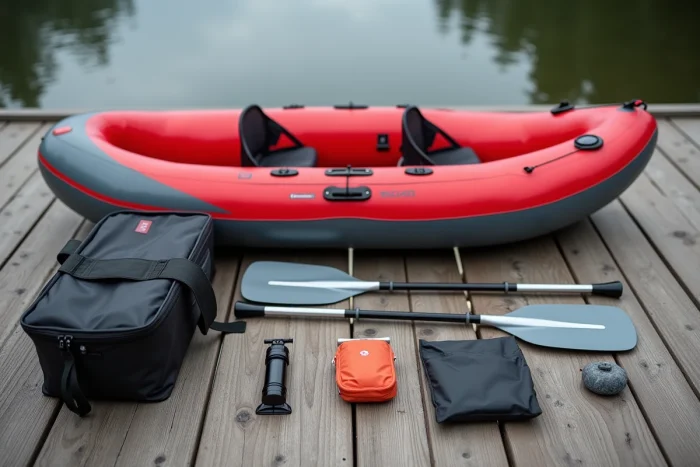
For a couple with a child, this means three vests in the correct sizes. You also need to add paddles (often not included with the kayak), a pump compatible with the Boston valves of the Tahiti Plus, and possibly a waterproof bag for personal belongings.
- Buoyancy vests 50 N: one per person on board, adjusted to fit (child vests are not interchangeable with adult vests)
- Appropriate paddles: two double-bladed paddles for use by two, check the length according to the width of the kayak
- Pump compatible with Boston valves: inflating through the five valves of the Tahiti Plus is theoretically possible but takes a lot of time
- Waterproof bag and towing line: recommended by the FFCK for any outing, even on a closed water body
The accessory budget can equal the price of the kayak itself, which traditional buying guides rarely mention. Anticipating this overall cost avoids an unpleasant surprise on the day of the first launch.
Durability of PVC and Usage Conditions of the Sevylor Tahiti Plus
The PVC of the Tahiti Plus is thin, consistent with the product’s price positioning, but this thickness imposes strict usage precautions.
Rocky surfaces, submerged branches, and launches on stony banks represent the main risks. A repair kit is generally provided, but patching a hole on an inflatable kayak by the river remains a delicate operation.
Water Areas Suitable for the Tahiti Plus
The verdict from the tests converges: calm lakes and rivers without submerged obstacles. Sea outings, even near the beach, expose the kayak to conditions (chop, back current, salt) for which it is not designed. The stability of the Tahiti Plus on flat water is one of its real strengths. Any choppy water reveals its structural limits.
Transportability and ease of setup remain the true assets of the Tahiti Plus. These two criteria matter a lot for a beginner who wants to put a kayak in a car trunk without hassle. The trade-off is reflected in paddling performance and material longevity.
The choice boils down to a question of priority: do the ease of transport and low price justify the compromises on rigidity and durability? Test data suggests that yes, provided use is limited to calm waters and occasional outings.