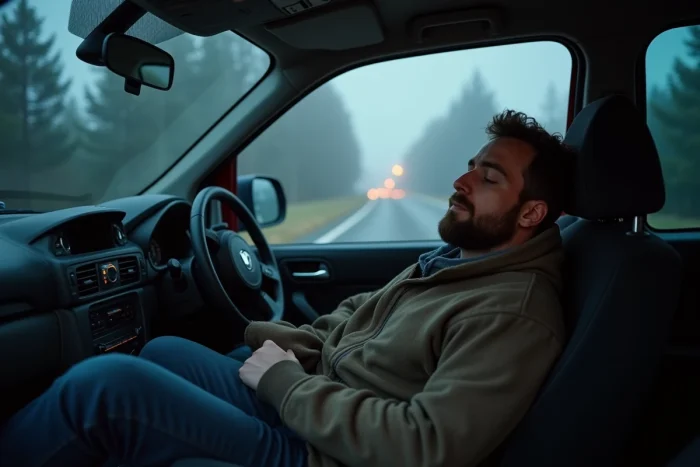
Sleeping in your car in Belgium is not subject to any explicit federal prohibition. The Belgian Highway Code does not contain any article sanctioning the act of spending the night in a parked vehicle. The nuance lies elsewhere: between municipal regulations, regional differences, and the emergence of new practices related to electric vehicles, the actual framework varies depending on where you park.
Nomadic electric vehicles and charging stations: a regulatory blind spot
The rise of electric vanlife raises a question that Belgian legislation has yet to address. Locations equipped with charging stations are generally found in commercial or public parking lots, subject to time-limited parking rules. Parking for several hours to recharge a battery while sleeping in the vehicle creates a conflict of use with motorists who are simply waiting to recharge.
None of the three Regions have published a text specifically regulating bivouacking at a charging station. Highway rest areas, which sometimes have charging stations, tolerate overnight stops, but their usage conditions do not allow for extended parking at a charging spot.
For a complete detail of the regulations for sleeping in your car in Belgium, the criteria remain the same as for a thermal vehicle: no equipment deployed outside the vehicle, no noise nuisance, no discharge of wastewater onto public roads. The type of engine does not change the legal status of overnight parking.
Night parking rules in Belgium: what the Highway Code says (and doesn’t say)
The reference document remains the note from SPW Mobility (CeMaphore No. 141, revised edition March 2021). It reminds us that no provision of the Highway Code prohibits spending the night in a parked vehicle. Road safety organizations even recommend stopping and sleeping in case of fatigue.
However, the conditions are precise:
- No equipment should extend beyond the vehicle (awning, table, chairs). Deploying a canopy or placing a step transforms the parking into “camping,” subject to different rules.
- No effluent (dirty water, gray water) should escape from the vehicle or be discharged onto public roads.
- No noise nuisance should be produced, which practically excludes external generators.
- No waste should be deposited on public roads.
As long as these four criteria are met, overnight parking is legal wherever regular parking is allowed without time limitation.
Differences between Wallonia, Flanders, and Brussels: regional comparison
The federal framework leaves significant leeway to the Regions and municipalities. The discrepancies are significant.
| Region | Night parking in a car | Wild camping | Specific restrictions |
|---|---|---|---|
| Wallonia | Allowed where parking is allowed | Prohibited unless agreed by the owner | Variable municipal regulations |
| Flanders | Allowed where parking is allowed | Prohibited in natural parks and public domains | Coastal municipalities often restrictive |
| Brussels-Capital | Tolerated on public roads, prohibited in public parks since 2024 | Prohibited | Explicit prohibition in public parks |
The Brussels-Capital Region has hardened its position by explicitly prohibiting sleeping in a parked vehicle in public parks since 2024. This measure primarily targets precarious situations but also applies to travelers in vans or converted cars.
In Wallonia and Flanders, it is the municipalities that set local restrictions. Some tourist municipalities in Flanders prohibit overnight parking of camper-type vehicles in their coastal parking lots. Others, in Wallonia, offer dedicated rest areas for campervans, indicated by the E9h sign.
Rest areas and designated spots: where to legally park at night
Rest areas along the highways remain the simplest option. Parking is allowed there without time limit in standard spots, and tolerance for short nights is well established.
Outside the highway network, several municipalities in Wallonia and Flanders have created parking zones reserved for motorhomes, identified by the E9h sign. These spots also accept cars, provided they do not encroach on a space sized for a campervan.
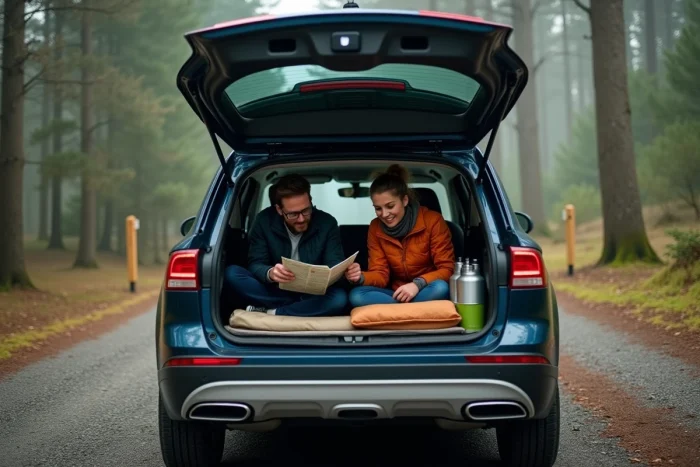
National parks and nature reserves apply their own rules. Wild camping is almost systematically prohibited there, and overnight parking in access parking lots is often limited by time barriers or prohibition signs during certain hours.
Tips for identifying suitable spots
- Check local signage before settling in: an E9a sign allows all categories of vehicles, but the duration may be limited by an addendum.
- Consult vanlife community apps (Park4Night, iOverlander) to find recent feedback on a specific spot.
- Prefer highway rest areas or large surface parking lots on the urban outskirts, generally more tolerant than city centers.
Wild camping and bivouacking in a car: the legal boundary
The distinction between “sleeping in your car” and “camping” is based on a physical criterion: as soon as equipment is deployed outside the vehicle, it is considered camping. An unfolded rooftop tent, an awning extended, or a table set up next to the vehicle transforms parking into a camping activity, subject to specific permits.
Wild camping is prohibited throughout Belgium without permission from the landowner. On private land, written or verbal agreement from the owner is sufficient. On public land, only officially designated areas allow it.
This distinction has practical consequences for rooftop tent users. According to Stoemelings.be, a folded rooftop tent does not change the vehicle’s status, but an unfolded rooftop tent legally constitutes camping. The nuance lies in the state of the equipment at the time of a potential inspection.
The Belgian framework remains relatively permissive for those who sleep discreetly in their closed vehicle, engine off, without external setup. The areas for evolution mainly concern the integration of charging stations into future bivouac areas, a topic that neither the Regions nor the federal government have yet formalized.