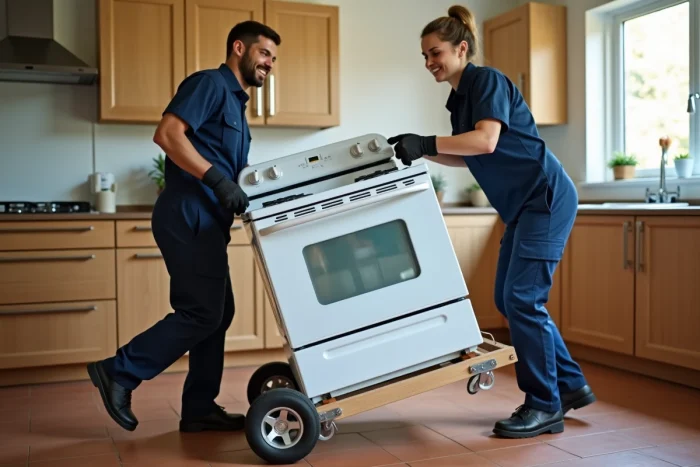
An electric stove contains neither refrigerant gas nor a compressor, which simplifies the transport issue compared to a refrigerator. However, laying it horizontally remains a risky action for the internal connections and heating elements. Whether laying an electric stove down is possible depends on the model, the duration of the journey, and the securing conditions.
Maritime freight and long-distance transport of an electric stove
Moving guides focus on the van journey between two homes. They overlook an increasingly common scenario: shipping by sea container, where the stove may spend several weeks at sea, subjected to rolling and vibrations.
In a container, the appliance must be secured flat in a reinforced box made of OSB or marine plywood. The horizontal position then becomes the norm, not the exception, because the vertical stacking of boxes in a twenty-foot container requires maximizing floor space.
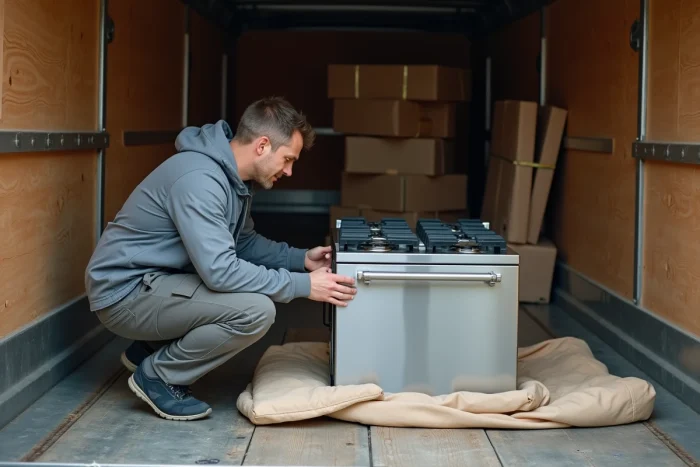
The main constraint is the risk of oil reflux from the heating elements to the connectors. The tubular heating elements contain a thin layer of insulating oil around the resistive wire. In prolonged horizontal positioning, this oil migrates by gravity towards the connection terminals. We recommend draining the oven cavity and protecting each connector with high-temperature insulating tape before boxing.
For securing in the box, wooden battens screwed around the base of the appliance prevent any lateral movement. Polyethylene foam padding between the inner walls and the stove casing absorbs shocks related to freight. If you are wondering if one can lay an electric stove down on such a journey, the answer is yes, provided these preparation steps are followed.
Internal damage related to inclined transport: what actually breaks
Feedback from repair services indicates an increase in malfunctions of heating elements after a non-vertical move. The problem is not structural: the chassis of an electric stove easily supports the lying position.
The weak point is at the level of the internal electrical connections. When the appliance tips, the insulating oil from the heating elements can seep into the terminals and cause a false contact when power is restored. The typical symptom: a plate that heats unevenly or an oven that no longer reaches temperature.
- Tubular heating elements: check for any signs of oil on the terminals after transport, clean with a cloth soaked in isopropyl alcohol before connecting
- Electronic control panel: the boards of induction models are sensitive to lateral shocks, specific rigid foam padding around the control panel is necessary
- Oven door: the spring hinge mechanism can become detached if the appliance falls on its front face, removing the door before transport reduces the risk and lightens the overall weight
- Adjustable feet: screw them fully into the chassis to prevent them from bending under the weight of the lying appliance
The updated Bosch-Siemens guide in 2026 specifies that induction models require a vertical resting time of several hours before being put back into service after lying transport. This delay allows the insulating oil to return to its original position in the heating elements.
CSA standard and 30-degree inclination: a North American approach applicable in France
CSA standards in Canada allow a limited inclination of up to 30 degrees for electric stoves, provided that the oil is pre-drained. This tolerance reduces the risks of reflux while imposing a resting time of 24 hours before being put back into service.
In Europe, no equivalent standard sets a maximum angle for transport. Manufacturers merely recommend vertical transport. We observe that the Canadian approach offers a realistic compromise for moves in narrow staircases or freight elevators, where strict vertical passage is sometimes impossible.
Tilting the stove at a maximum of 30 degrees rather than laying it completely down limits oil migration. If the journey lasts less than an hour, this moderate inclination generally does not cause malfunction upon restarting.
Concrete preparation before moving an electric stove
Disconnecting the appliance is not limited to unplugging the cord. For a stove connected in three-phase or with a dedicated cooking cable, the rear terminal block must be checked to ensure that the wires will not be pulled during handling.
- Remove the grates, trays, and drip pan from the oven, pack them separately in cardboard with bubble wrap
- Seal the oven door in the closed position with wide tape to prevent it from opening during transport
- Protect the ceramic or plate surface with a layer of rigid cardboard secured with tape, never directly with cling film that sticks and leaves residues
- Wrap the entire appliance in a moving blanket, paying special attention to the corners of the chassis
For moving within the home, a low platform strap cart remains the most suitable tool. The stove weighs on average between 40 and 60 kg depending on the models: at least two people to lift it, three if stairs are involved.
Recommissioning after lying transport
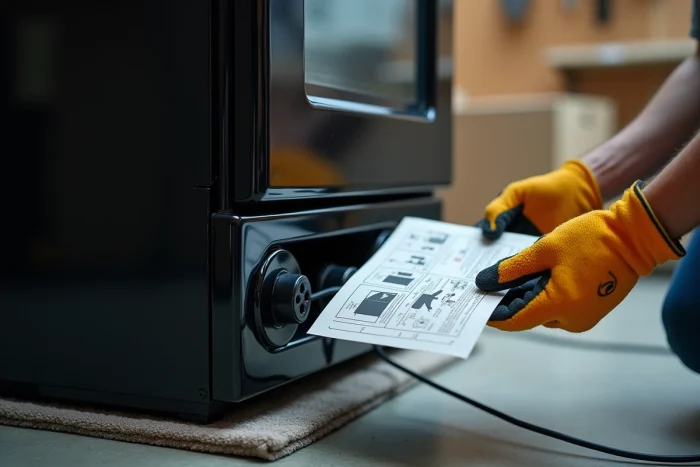
Once the appliance is returned to a vertical position in the new home, do not plug it in immediately. Allowing the stove to rest upright for several hours allows the internal fluids to stabilize. Canadian standards prescribe 24 hours, which provides a comfortable safety margin.
Before the first heating, open the rear panel to visually inspect the connections. Any trace of oil on the terminals warrants cleaning. If the oven emits an unusual odor during the first cycle, cut the power and ventilate: this is most often residual oil burning, posing no immediate danger but indicating that the heating elements need cleaning.
Laying an electric stove down for a move remains a manageable maneuver provided the appliance is prepared, the angle and duration of inclination are limited, and a vertical resting time is respected before reconnection. For long-distance freight, reinforced boxing with full padding transforms a risk into a simple logistical precaution.