
You have just received your property tax notice and the amount seems too high. Or, upon rereading your lease, you find that the indicated living area does not match what you measure at home. Correcting a misreported living area is an accessible process, provided you know where to start and prepare a solid file.
Living area, Carrez area, tax area: understanding which one to correct
Before any claim, a preliminary question arises: which area are we talking about exactly? The confusion between these concepts is the primary cause of rejected or misdirected requests.
The living area corresponds to the constructed floor area, after deducting walls, partitions, stairs, steps, and door and window frames. Unfinished attics, cellars, basements, garages, and unheated verandas are not included.
The Carrez area applies only to condominium lots. It excludes areas where the ceiling height is less than 1.80 m but includes certain spaces that the living area ignores.
The tax area, which serves as the basis for calculating property tax, follows its own rules. It appears on the cadastral evaluation form held by the property tax office. If your goal is to lower your property tax, it is this area that needs to be checked, not that of the lease or the sales deed. You will find procedures on Bâtir Architecte that detail the calculation methods specific to each reference framework.

Cadastral evaluation form: the document to request before any claim
Many property owners directly file a claim with the tax office, reporting an area error. The problem is that they contest a figure without knowing where it comes from. Requesting the cadastral evaluation form is the first concrete step.
This document, available from your property tax office, details the composition of your property as the administration knows it: number of rooms, areas recorded room by room, comfort elements taken into account. You can request it by mail, by email, or directly at the counter.
What the form often reveals
By comparing the form with the reality of your housing, you will precisely identify the discrepancy. Several cases frequently arise:
- A garage or a cellar counted as a living room when it should not be
- Unfinished attics included in the area, despite insufficient ceiling height
- An extension or a veranda never built but listed in the cadastral records after an old building permit
- An error in reporting during a previous declaration, sometimes dating back several decades
Without this form, you risk contesting a global figure without being able to point out the precise error, which weakens your file.
Preparing a solid correction file for the tax office
Once the discrepancy is identified, the correction involves reporting it on the “Manage my real estate” (GMBI) portal or through a written claim. This report can be made at any time, without waiting for a declaration campaign.
On GMBI, the option to look for is “reporting erroneous description.” This is not the declaration of occupancy (which concerns the use of the property), but rather a modification of the recorded physical characteristics.
The documents to gather to support the request
A well-prepared file speeds up processing and limits back-and-forth with the administration. Building professionals recommend gathering:
- Dimensioned plans of the housing, made by yourself or by a surveyor, with the dimensions of each room
- The details of your area calculations, specifying the method used (living area as defined by the Construction Code or tax area)
- Datable photos of the concerned spaces, especially if you contest the habitability of a space (insufficient height, absence of a window, technical room)
- A copy of the cadastral evaluation form, annotated to show the lines you contest
A documented file with plans and photos reduces processing times. The administration may send an agent to verify on-site, but a complete file sometimes makes this visit unnecessary.
Tax consequences of correcting living area
If the administration validates your request, the tax base for your property tax will be recalculated. The correction generally applies to the current year and may lead to a refund of overpayments for previous years, within the limit of the claim period.
The financial impact depends on the area discrepancy and the rental value of your municipality. Even a few square meters less can significantly change the annual amount.
When to call in a measurement professional
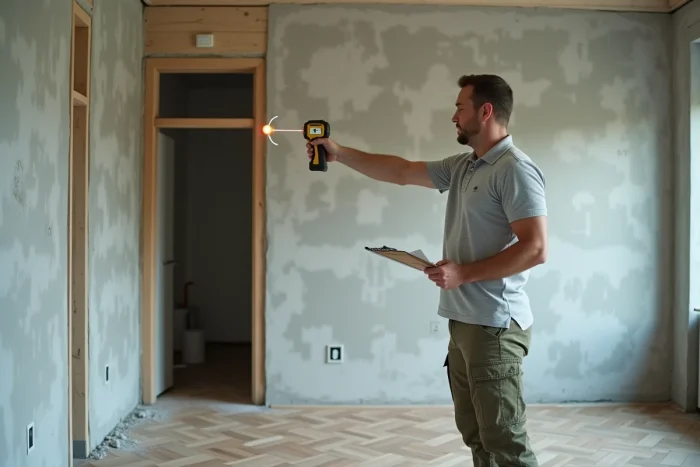
If the discrepancy is small or if you are not comfortable with the calculation rules, involving a certified property surveyor secures the process. Their measurement report has a technical value that the administration takes into account.
For older properties that have undergone several renovations or extensions, the actual areas often differ from what is recorded in the cadastral records. A professional will be able to distinguish what falls under the living area, the tax area, and non-countable annexes.
Correcting the living area is not a complex procedure, but it requires method. Identifying the correct reference framework, obtaining the cadastral form, and then compiling a precise file with dimensioned plans: these three steps are sufficient in the vast majority of cases to obtain a correction from the tax administration.