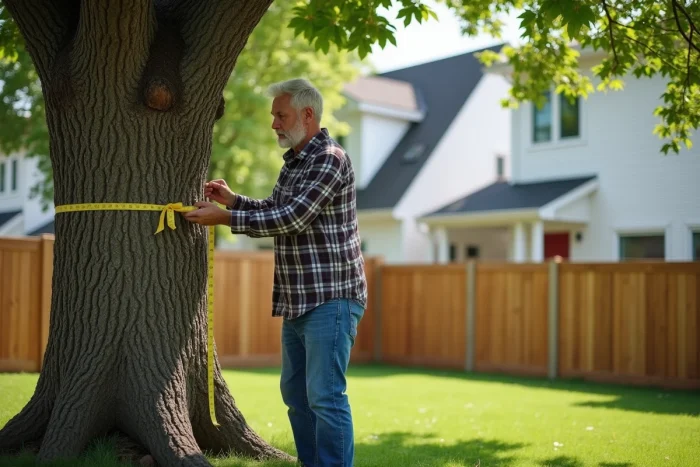
Two meters is the red line. Not a centimeter less, or you risk having to uproot your brand new tree, unless a local text has decided otherwise. The Civil Code leaves no room for doubt: minimum distances are imposed, sometimes challenged by a municipal order or rules in place for generations. Thirty years is the threshold. If your tree has taken root without contest for all this time, the page is turned, and the distance no longer matters. Neither the nature of the tree nor the goodwill of the neighbor can change that.
Legal distances to respect between a tree and a dwelling: what the law provides
The question of the minimum distance to observe when planting a tree near a house is based on a long-established balance protected by the Civil Code. Article 671 sets clear limits: any tree or hedge exceeding two meters in height must be planted at least two meters from the boundary separating the properties. For trees, shrubs, or hedges that do not exceed this threshold, the distance drops to fifty centimeters. This framework applies unless a local urban plan (PLU) or a subdivision regulation imposes a different rule.
Here is what the law states in broad terms:
- Height greater than 2 meters: the planting must be at least 2 meters from the property line.
- Height less than or equal to 2 meters: the minimum distance drops to 50 centimeters.
With certain species that have invasive roots (poplar, willow, silver maple), caution is required: a setback of fifteen meters is often necessary to avoid cracks and damage to neighboring constructions. Furthermore, the PLU may protect certain trees, strictly regulating their planting, cutting, or uprooting.
Respecting the distance to respect between a tree and a house is not just a matter of courtesy: it is a constraint provided by law. However, a planting tolerated for more than thirty years benefits from a prescription that makes it unassailable. Notarial acts or easements can also influence the rule, depending on what is stated in the title of ownership and local practices.
How to check if your planting complies with local regulations?
A tree encroaching on the boundary, a vigilant neighbor, a project for an extension… The question of the legal distance tree house quickly comes back to the forefront. The Civil Code provides the framework, but each municipality, each neighborhood, sometimes each parcel, can impose its own specific rules through the local urban plan (PLU) or a subdivision regulation.
First and foremost, contact the town hall. The urban planning department holds the official and up-to-date version of the PLU. This document often details, zone by zone, the minimum distances to be respected, the prohibitions on certain species with powerful roots, and the list of protected trees. This information, available online or on-site, is crucial.
In certain areas, old agreements between neighbors have become local practices, complementing or adapting the general legislation. A quick check of your title of ownership is necessary: it sometimes mentions a planting easement, a specific notarial act, or a thirty-year prescription that changes the situation. Depending on the case, these elements allow for more flexibility or impose additional constraints.
In this context, dialogue with neighbors remains an asset: a clear explanation, a written agreement, and many disagreements can be defused. Regulations can evolve. In case of non-compliance, legal remedies exist, which can go as far as the uprooting of the concerned tree.

Anticipating and managing neighborhood conflicts related to tree distances
Roots invite themselves wherever they please, and branches often do as they wish. A tree planted too close to the property line quickly becomes a source of tension, especially if its branches overhang the neighboring land or if its roots cause damage. The Civil Code regulates these situations: the owner must maintain their trees and, at the neighbor’s request, trim the overhanging branches. If roots, brambles, or twigs cross the boundary, the neighbor can cut them themselves, without prior steps.
When a planting is installed exactly on the boundary of the properties, it is considered joint. Maintenance, harvesting of fruits or flowers is done equally. As for espalier plantings on a party wall, they are exempt from minimum distances, provided they do not exceed the top of the wall or weaken its structure.
A poorly maintained tree or a branch that falls during a gust of wind engages the owner’s liability. Unless it is an officially recognized natural disaster, this liability does not disappear. Home insurance generally takes over, subject to compliance with the stipulated clauses.
If dialogue falls short, several avenues remain possible: conciliation with a justice conciliator, or, as a last resort, bringing the matter to the judicial court. Before reaching that point, it is better to communicate, document each step, and keep all supporting documents. Respecting the legal distance between tree and house reduces the risk of disputes, but only constant vigilance can prevent unpleasant surprises and preserve neighborhood peace.
A well-placed tree does not cast a shadow over neighborly relations. Just one meter too much or too little can change the situation, at the root as well as at the top.