A burrito taken out of the refrigerator presents a problem that most reheating guides overlook: the tortilla and the filling do not respond to heat in the same way at all. The wheat tortilla loses moisture on the surface and hardens quickly, while the rice, beans, or meat inside take longer to reach an even temperature.
Reheating a burrito without drying it out thus involves managing two opposing textures at the same time.
Whole burrito or separate filling: what each approach changes
The most common temptation is to reheat the burrito as is, just like one would do with a slice of pizza. The problem is simple: the outer tortilla is thin and directly exposed to the heat source, while the dense and moist filling acts as a thermal block that heats up slowly.
Reheating the whole burrito works if the method protects the surface while the core heats up. However, if the filling contains fragile elements (lettuce, sour cream, guacamole, pico de gallo), removing them before reheating and then putting them back afterward results in a much cleaner mouthfeel.
When the filling is homogeneous (rice, beans, braised meat, cheese), treating the burrito as a block remains the best option, provided you cover the tortilla to trap moisture during the initial heating phase. This principle, applicable to all methods, makes the difference between a soft tortilla and a cardboard-like one.
Those looking to reheat a burrito easily without sacrificing texture will benefit from choosing their method based on the type of filling rather than the available equipment.
Comparison of reheating methods for a burrito
Not all methods protect the tortilla in the same way. The table below summarizes the differences observed between the four most common approaches, applied to a standard-sized refrigerated burrito.
| Method | Estimated Time | Tortilla Texture | Filling Evenness | Risk of Drying Out |
|---|---|---|---|---|
| Microwave (with damp cloth) | Quick | Soft but mushy | Medium (possible hot spots) | Low if covered |
| Low oven (covered then uncovered) | Longer | Slightly crispy | Good | Low |
| Skillet over medium heat | Moderate | Golden and crispy | Uneven (hot outside, warm center) | High without lid |
| Combination microwave + skillet | Moderate | Soft inside, golden outside | Good | Low |
The key takeaway from this comparison: no single method provides both a well-heated core and a crispy tortilla without a protective step. The combination of two methods yields the best overall result.
Reheating a burrito in the oven without drying it out
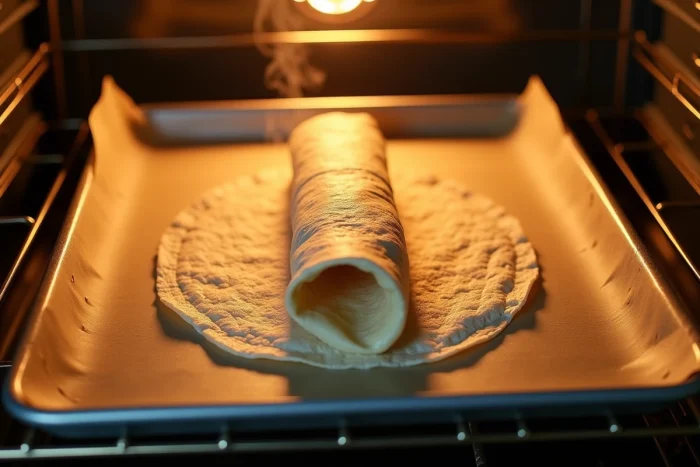
The oven remains the most reliable method for a whole burrito with a dense filling. The principle is based on a covered phase followed by an uncovered phase.
- Wrap the burrito in aluminum foil, leaving a small opening at the top to prevent steam from making the tortilla soggy, then place it in the oven at a low temperature.
- After most of the heating time, remove the foil for the last few minutes to firm up the surface without making it brittle.
- Do not preheat the oven to a high temperature: an oven that is too hot dries out the tortilla before the center of the burrito is reheated.
Covering at the beginning and uncovering at the end exactly replicates the logic that also works for tortillas alone and tamales. The partial covering traps enough steam to hydrate the tortilla while the heat penetrates the filling.
The combined microwave and skillet method
This two-step approach addresses the main flaw of each method taken in isolation. The microwave raises the internal temperature of the filling without exposing the tortilla to prolonged dry heat. The skillet, used afterward, restores crispness to the surface.
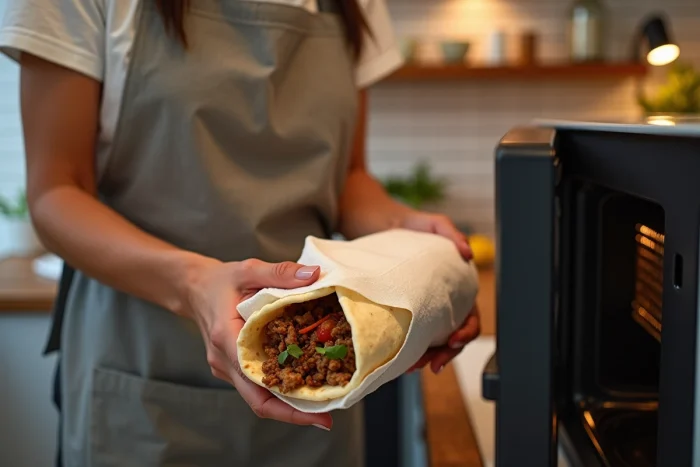
For the microwave phase, wrapping the burrito in a slightly damp cloth prevents the tortilla from stiffening. The moisture in the cloth turns into gentle steam that keeps the dough flexible. A few short bursts are better than one long burst, as the microwave heats unevenly and creates hot spots next to lukewarm areas.
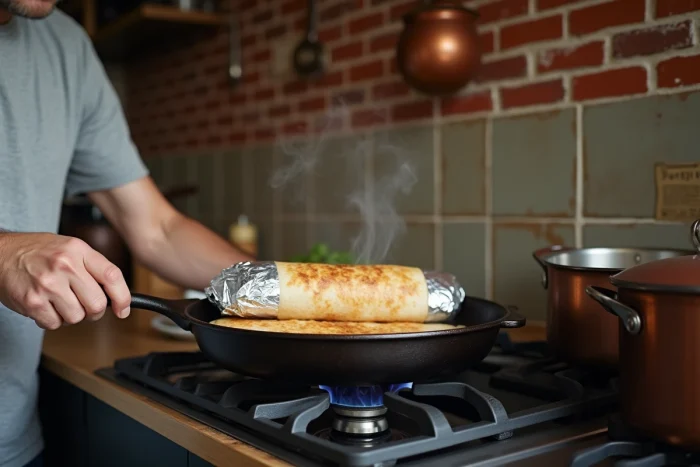
Immediately afterward, place the burrito in a skillet over medium heat, without any fat or with very little. Direct contact browns the tortilla in a matter of moments. Turn the burrito to sear each side evenly.
Unlike the skillet alone (where the inside often remains cold when the outside begins to burn), this combination ensures a hot core and a crispy shell.
Fragile fillings: remove before reheating
A burrito filled with lettuce, guacamole, or sour cream cannot be reheated as a whole. These ingredients degrade with heat: lettuce wilts, guacamole oxidizes, and cream spoils.
The most effective approach is to open the burrito, remove the raw or emulsified elements, reheat the base (tortilla, meat, rice, beans, cheese) using the method of your choice, and then reassemble everything with the cold toppings.
Separating fragile toppings before reheating takes an extra minute but avoids the mushy texture that makes a reheated burrito disappointing. This simple gesture distinguishes a decent result from a truly appetizing one.
The tortilla itself benefits from this disassembly: freed from the wet weight of the filling, it dries less quickly when exposed to heat and more easily regains its original flexibility.
Thus, the choice of method depends less on kitchen equipment than on what is inside the burrito. A “fully cooked” burrito (rice, black beans, braised meat) can be reheated whole in the oven or using the microwave-skillet combination. A “fresh” burrito with raw vegetables and cold sauces requires disassembly. In both cases, protecting the tortilla from direct heat during the temperature rise remains the principle not to overlook.