
France trains entire cohorts of visual effects specialists for cinema, TV series, and video games each year. Several national schools rank in international standings, and French studios attract foreign productions thanks to a favorable tax framework.
The question is no longer whether quality VFX training exists in the territory, but rather what it covers, what it does not cover, and where the blind spots are compared to Anglo-Saxon curricula.
VFX Tax Credit and Attractiveness of French Training Programs
The regulatory framework directly impacts the quality of available training. The extension of the VFX tax credit to 30% for local productions strengthens the activity of studios based in France, generating recruitment needs and prompting schools to adapt their programs to actual production pipelines.
This dynamic has a concrete effect: schools that integrate tools like Unreal Engine 5 into their curricula respond to a direct demand from studios. Rubika and MOPA, for example, are among the institutions that have taken this turn towards hybrid training combining practical and digital effects.
For those looking to train in special effects without going abroad, the French market offers an ecosystem where schools and studios work closely together, facilitating internships and job placement. The CNC’s Visual Effects plan, which had already created several hundred jobs in a year at its launch, continues to structure the sector.
Special Effects Schools in France: Comparative Table of Specializations
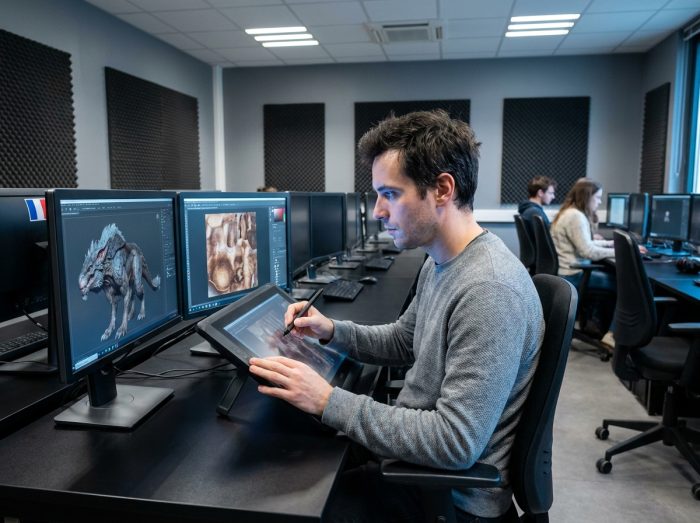
Not all schools train for the same professions. Some focus on 3D animation and compositing, while others include modules on practical effects (pyrotechnics, models, mechanical effects). This table summarizes the main orientations of the most frequently cited institutions in the sector.
| School | Dominant Specialization | Practical Effects | Real-Time Pipeline (Unreal, etc.) |
|---|---|---|---|
| ESMA | 3D Animation, Compositing | No | In the process of integration |
| Rubika | Animation, Digital VFX | No | Yes |
| MOPA | 3D Animation, Animation Cinema | No | Yes |
| ArtFX | VFX, Video Game | Occasional Modules | Yes |
| Live Performance Training | Stage Effects (Pyrotechnics, CO2) | Yes | No |
The “practical effects” column reveals an imbalance. Almost all French VFX programs are digitally oriented. Skills in physical effects (controlled explosions, smoke, models) fall under a different training circuit, often related to live performance.
Practical Effects and Pyrotechnics: The Limitation of Digital Curricula
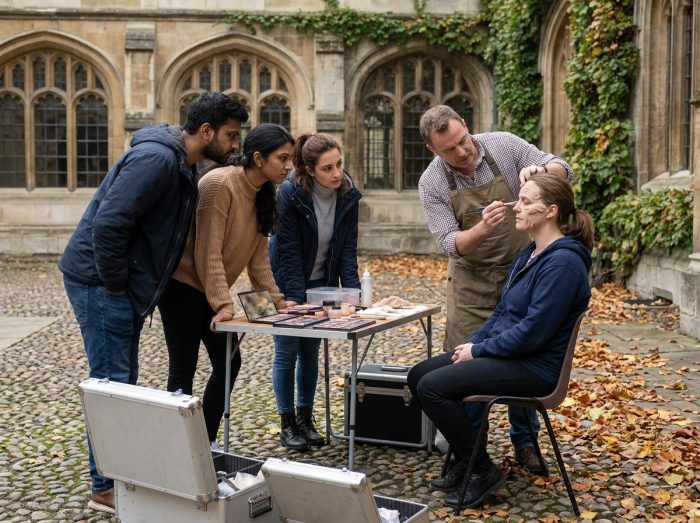
The special effects sector is not limited to CGI. French TV series are increasing their VFX budgets and are increasingly using “in-camera” effects (shot on set rather than added in post-production). This trend, documented for several years, creates a demand for technicians trained in physical effects.
Theme parks represent another underestimated outlet. Disneyland Paris, for example, recruits special effects technicians on fixed-term contracts for positions related to pyrotechnics, CO2 effects, and stage devices. These profiles do not come from 3D animation schools.
The problem: in France, no generalist VFX school trains in on-set pyrotechnics. Pathways go through specific certifications related to live performance or through company apprenticeships.
- French VFX schools cover compositing, motion design, 3D animation, and matte painting, but rarely mechanical or chemical effects.
- Training in stage effects (fire, water, smoke on set) depends on distinct pathways, often linked to the performing arts.
- The transition from a digital specialization to a field skill requires additional certifications (pyrotechnic qualifications, fire safety).
France or Abroad: Where Does the Real Gap in VFX Training Lie?
On the pure digital side, the gap between France and Anglo-Saxon countries has narrowed. ESMA regularly appears in global rankings of animation schools. French graduates work in studios in London, Montreal, and Los Angeles, attesting to the international recognition of their programs.
In contrast, American or British programs more often offer cross-disciplinary modules that integrate practical and digital effects within the same curriculum. A student at the Vancouver Film School or the National Film and Television School in London may be exposed to green screen, Nuke compositing, and managing physical effects on set.
The other difference lies in the professional network. Schools located near major production hubs (Los Angeles, London, Vancouver) provide direct access to internships on high-budget productions. French schools partially compensate through the tax credit that attracts international shoots to the territory, but the volume of heavy VFX productions remains lower than that of Anglo-Saxon markets.
Training in special effects in France without going abroad works for digital professions, provided one targets a recognized school and accepts that the initial professional network will be more limited. For practical effects, the pathway remains fragmented and requires additional training outside the traditional circuit of film schools. The choice depends less on the country than on the targeted specialization.